Tuesday, October 14, 2008

The Memory Room

By Christopher Koch


The first sentences of the blurb read:
'What is a spy? Are they born, or are they made?' With these words, Vincent Austin analyses his future occupation. Some spies are made, he says, but his kind is born. He is devoted to secrecy for its own sake.

It sounds like an exciting spy-novel. However, this is by no means a conventional espionage thriller. It's not an espionage novel at all really, except for maybe a chapter in China where a fantastic picture is painted of Chinese politics before, and during, the rule of Deng Xiaoping.

The novel follows two best friends, Vincent Austin and Derek Bradley, on their separate journeys from a sleepy Hobart up through the ranks of ASIS - the Australian Secret Intelligence Service.

The Memory Room reeks of great thriller potential from the very first page but is largely unfufilling and disappointing. There is also something unnerving about a meeting in a coffee shop in Canberra's "Civic centre" and trenchcoats by Lake Burley Griffin. To me, this suggest more of porn-trading politicians than top spies at the height of the Cold War.

To me, the best thing about reading this novel was the difference and changes in Hobart between the 1950's and the 1990's. Other than that pretty picture, I was left wanting a lot more from such an acclaimed author.

Monday, August 4, 2008

August's Book!

What? An actual book to be read and reviewed???

*Gasp*!

Eh, we all have busy busy lives and whatnot, but I've had this book, The Book Thief by Markus Zusak sitting Unopened and Unread on my bedside table for a couple of months now... so lets read it together...

RV back here on Aug 15!

Tuesday, July 29, 2008

The Charlie Novelettes

As told by Vince Noir


The Charlie Novelettes focus on the central character, Charlie and his journey from the rock-and-roll era of the 70s through to the mass-consumerism era of the 90s / 00s.

This collection of stories deals with all the trials and tribulations that are faced by the youth of today. The relevance is frightening.

Overall, I'd say that the Charlie Novelettes are a great light read. The crayon drawings really add to the general feeling of calm that is generated just by holding Charlie.

A must read / am surprised this is not in Angus & Robertson's "100 books you must read before you die"

Tuesday, June 24, 2008

Tokyo Station


This book follows the story of Harry Niles; son of American Missionaries that has grown up on the streets of Tokyo.

Harry is an undesirable type who owns a bar in Asakusa and regularly cheats people for money and business.
The book focuses on Harry's life and his plans to leave Japan before the inevitable break out of WWII. However it isn't so simple as he is hunted by a Samurai and several dealings from his shady past have come back to haunt him.

All in all, it's a very disappointing book from an author i thought would have offered a lot more.


This review isn't useful unless it stops you from reading this book. Unlike other Cruz Smith books, I can't paint such a great picture of Tokyo (as opposed to really feeling like being in the Soviet Union in the Gorky Park Series) and the character of Harry Niles just isn't believable.

Friday, April 25, 2008

The Ex-Boyfriend's Handbook.

Firstly, my apologies for forgetting to write this up earlier. Its 10:30 on Anzac Day and I have nothing better to do than write a book review. How sad.

Moving on.


The book I chose for this month was The Ex-Boyfriend's Handbook by Matt Dunn. From picking up the book and a quick perusal of the blurb I surmised it would be something like Bridget Jones' Diary, from a male perspective. I wasn't wrong.

Edward has been happy in his rut of a life. Until his girlfriend (a bitch, by any definition) leaves him. In an attempt to win her back he overhauls his whole life. And in the space of three months goes from dud to STUD, overhauling the a to z of his life with the aid of his friends.

A variety of his adventures show us different aspects of Ed. And the characters contrast and promote his personality. Best mate Dan, is a player so shallow that he would make a mouse fart seem deep. He provides insight into what women want, how to read them and how not to be to keep one. Wendy the barmaid keeps Dan's rediculous ego in check, and provides insightful but witty one liners. And Sam is the glimmer of hope that keeps him going and gets to know Ed during his transformation, providing gentle encouragement along the way. And Natasha is a man eater. She allows Ed to see the vulnerable positions a woman puts herself in when she's in a relationship. And then she shags Dan. Which is pretty much a full circle of characters. Except for Billy the homeless guy who's too smelly or drunk to care if he's in the list.

One thing I would have liked out of this book would have been a little more closure with Jane. Yes, there was some but I wanted her to see him and talk to him, and realise that while she has gained in her life, she has also lost.

Overall I found it a nice book, good for a holiday read. Something you can sit at for a few hours on end or not pick up for a few days if you're busy. It was easy to read and very entertaining. I know I'll be looking for more of this authors work.

Tuesday, April 22, 2008

Polar Star

I should start by saying that i'm normally not a detective / crime novel kind of guy, but Martin Cruz Smith's Gorky Park Series has me totally hooked

Polar Star follows our hero, Arkady Renko, after he has essentially been exiled from Moscow by the KGB. He is working on the slime-line of a Soviet Factory ship which is buying fish from smaller, more skilled, American trawlers.

Like all Renko novels; there is a murder which he is to investigate. Like all novels, there is an attempted cover-up by everybody else and like all Renko novels, he persists when everybody is trying to force him not to.

What I love about this series (from what i have read) is the picture that Cruz Smith paints of life in Soviet Russia. It's as if he has been there and experienced it. In Wolves Eat Dogs, i have never read a better description (whether it be entirely accurate or not) of Chernobyl and surrounding villages. I just can't get enough of it.

The Gorky Park / Arkady Renko Series

Gorky Park *
Polar Star *
Red Square
Havana Bay
Wolves Eat Dogs *
Stalin's Ghost

*I have read these, and plan on reading the rest very soon.

Tuesday, April 8, 2008

A Long Way Down

By Nick Hornby.


A Long Way Down is the sotry of four people who randomly meet after deciding to kill themselves, by throwing themselves from a building, on new years eve. Except they all choose the same place and a bond / pact is formed so that they can help each other.

The story is narrated by all four characters (Maureen, Martin, Jess and JJ) who have completely different reasons for trying to do what they all wanted to do. The group (or 'gang' as they put it) are sometimes led down a completely unbelievable path by Jess' antics.

I could not stand the character of Jess, not one bit. If you read it i am sure that you will agree too, the only problem is, she is essential to the story.

Maureen's character, for that matter, was rather boring.
The only real entertainment i received from reading this book was through JJ and Martin, which is just over half the book.

The book also doesn't achieve anything at the end. it just ends, like that. done. None of them are feeling any better (except Maureen), but at least none of them have committed suicide (i don't think that gives anything away).

Having said all this, i couldn't put this book down and read it in 3 days (i was a bit over it from about 3/4 of the way through though).

It's entertaining, it's easy and it is very well written.

Tuesday, April 1, 2008

Long Way Down

Ewan McGregor and Charlie Boorman.

This book follows on from their success from their Long Way Round adventure. It's more of a diary than anything else. Put together by the two of them, telling the almost day-to-day activities of their adventure.

There are two main things i picked up from this book.

1. They are selfish and
2. Charlie Boorman is a real dick (which was further highlighted to me after seeing some of Long Way Round on dvd).

There is no doubt about it. Riding what they rode is a phenomenol task. They tell us how hard it is and how awesome the two of them are for doing it.

But what about Claudio??

Claudio is one of the cameramen. He rides just as much as they do (in both adventures) but he films it all too.
Does he get any credit? No.
Does he get mentioned often? No.
It's almost like he is Tenzing Norgay or something and it really pissed me off.

This isn't as good as LWR as they have to complete it faster (and, boy, don't they let us know about it).
They are both constantly whingeing and complaining about things that, especially after LWR, they should have semi-factored in.

Don't bother reading this book. It's boring and painful and there is the obvious impression, for me, that Charlie Boorman is a real tosser.


Sunday, March 30, 2008

Next book


Greetings all. Yes, I'm still alive and I'm back in the fray! I do, however, have a small problem. It's been so long since I've logged in with the admin login that I've either forgotten the password. That, or yahoo has killed the address. I'm not sure which. Soooo, I can't actually change the book to read on the sidebar at the moment. Phish has chosen one, though - The Ex-Boyfriend's Handbook, by Matt Dunn. So, go to and we'll reconvene on, say, Anzac Day for discussion?


Tuesday, March 18, 2008

The Three Musketeers


Alexandre Dumas' other classic novel. The Three Musketeers is, by-and-large, completely different from the movies i had seen. It is set much earlier in the lives of the four heroes and begins with d'Artagnan's journey from his country life in Gascony to his, eventual, leadership role within the Musketeers.

Being a complete history nerd, I absolutely love the fact that Dumas uses historically accurate people and events throughout the novel that our heroes (d'Artagnan, who is a real historic figure, Athos, Porthos and Aramis who are all fictional) are faced with.

This is an extremely well written book that explores the topics of friendship, love, loyalty, honour, pride and revenge.

First published in English in 1846 this book also highlights the sexist nature of the time and the periods leading up to that (it is set in the early 17th Century). Many times a female narrator is often complaining how it is unfortunate she is a woman else she'd be able to undertake some task that she can otherwise not do.

Overall it's a light-hearted and entertaining read that I would say is no essential, but if there is nothing else on the bookshelf on a rainy day then don't hesitate to pick it up.

Monday, February 18, 2008

Old School - Tobias Wolff

Every time I hear about a new Tobias Wolff book I have the same reaction. “Oh, Tobias Wolff,” I think to myself. “He gets a very good rap, but really he’s nothing special”. Then I receive a copy of said book (my Dad is a fan) and sit down to read it. Six hours later I notice that the house is dark and rather than wait for me to stop reading, Grizzlewick has learned how to drive, got a job and earned enough money to buy himself McDonalds for dinner.

‘Old School’ is no different. Semi-autobiographical (as much of Wolff’s work is), it relates the story of an exclusive boys’ school in the 1960s, and the competition between its senior English class to earn an audience with, among others, Ernest Hemingway. Following visits to the school by Robert Frost and Ayn Rand, the boys become feverish at the prospect of a meeting with Ernest Hemingway, a firm favourite and undisputed living national treasure.

Wolff, as anyone who has read ‘This Boy’s Life’ can attest, takes a curious attitude to his own life and that of his protagonists. He is unapologetic about his flaws and behaviour, viewing them with a detachment, but not egotism. His exploits, such as the forging of a report-card which earned him a place at the prestigious school, described in This Boy’s Life, are presented without apology, but also without bluster. It is clear that in his adult life, Wolff has had the introspection to understand that his actions were not exemplary, but acknowledges their contribution to the richness of his life.

This story is compelling not only for its tension and character, but also for its exposition of the craft of writing. The boys of the school are competitive, convinced of their own originality, and desperate to impress each other, their teachers, and visiting authors alike. I started reading it fascinated by the external intrigue, but I found I was compelled by another element – the presence of necessary lies and the diminution of uncomfortable truths. While this is a book about lies told and excuses made, the truth has a strange presence in this book – it’s not here to perform a liberating function, but rather something far more sinister. The truth, in this novel at least, does not have a liberating effect, it merely serves to frustrate.

With a frustrating realness of his characters, Wolff isn’t for everyone, but Old School is certainly worth pursuing if you’ve read and enjoyed other Wolff stories. If you’re new to Wolff, I suggest starting with ‘This Boy’s Life’, so long as it hasn’t been ruined for you as a VCE/HSC text.

Sunday, February 10, 2008

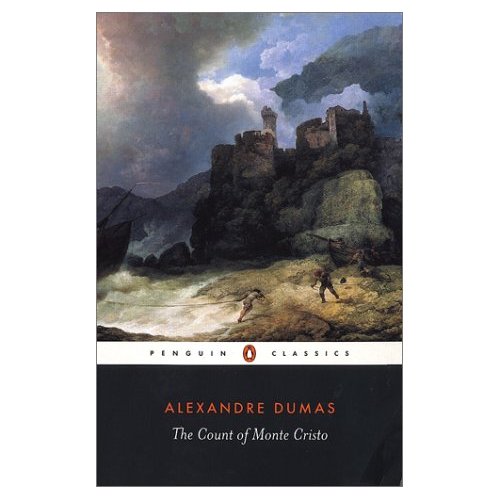
The Count Of Monte Cristo

is one of the two* most famous works by Alexandre Dumas


Most of you would/should know the story, either by reading the book or having seen one of the several movies that have been produced over the years (which, from recollection, are not as close to the book as hoped).

I am not going to go too much into the story itself, but more into the ideas and styles within it.

The two main themes throughout are the suffering of Edmond Dantés (later, the Count of Monte Cristo) and his revenge, which becomes the purpose of his life, on the three men that were responsible for his wrongful imprisonment.

The suffering and torment suffered by Dantés (he is imprisoned for 14 years) is immense, however what is portrayed by Dumas is not as bad as it could/should be for the reader to gain more of an insight into his later eccentricities. It is almost as if Dumas has glossed over a large part of it in order to get on with the rest of the story, the 'action' part. The only other story i could think of where such huge suffering was endured after wrongful imprisonment was For the Term Of His Natural Life by Marcus Clarke.

This isn't to say that the reader does not sympathise with Dantes, you most certainly do. I just believe you could sympathise more...

Dumas' writing style is not common in novels either. This was first published in installments in a French newspaper by a writer who had previously been writing mostly plays.
This leads to all the characters revealing their thoughts in theatrical ways by each performing small soliloquies in each scene.

This is a fictional novel, but it is set in historically accurate times. This makes the story even more engaging as the intertwining story of Napoleon attempting to regain rule of France (and how this affects Dantés) and the subsequent rule of the Bourbons after this is beautifully accurate.

There is a reason that this book is described as a "literary classic". It really is. I would recommend this book to anyone and everyone, even though my review was pox.

*The three Musketeers being the other (which will probably be my next review)

Wednesday, January 30, 2008

The Brontë Experiment

OK, I'm a girl who loves her Brontë (except Wuthering Heights, but let's not get into that here...) and I have just discovered that an old-but-new friend of mine has NEVER READ any Brontë!

Firstly, I am in utter astonishment that he has managed to survive so long without the exquisite prose of a Brontë running through his soul...

And secondly, I'm trying to work out what to start him on...

I adore and heart Jane Eyre to a degree that is possibly more than sane, but sometimes, if I whisper it quietly under my breath, I will admit to appreciating Agnes Grey and Tenant of Wildfell Hall just the teensiest bit more...

So, I'm asking you fellow drunkards... bearing in mind that he has actually asked for my recommendation, that he actually wants to read a Brontë... what would YOU suggest he read first?

Monday, January 28, 2008

Hellooooo???


Hi there Paper Drunkards - is there anything happening re December 07 and January 08?


Anyone?

Regards, MillyMoo

Saturday, December 15, 2007

In My Skin by Kate Holden

Firstly, before I actually get to the business of writing my two bob worth on this book, I'm not a confident book reviewer - especially given the quality of reviews the drunkards are accustomed to - I am intimidated, to put it bluntly. The thing is I really like reading and I really like a lot of books but I'm not very good at articulating what I like about particular books, so with that disclaimer in mind please read on...

In My Skin by Kate Holden made substantial ripples on the Australian book scene two years. As the title suggests, it is a memoir and it chronicles Kate's life as a heroin addict and prostitute, beginning with how she fell in with heroin in the first place to the predictable step of supporting her habit with prostitution. The meat of the novel is how she managed her heroin addiction and career as a sex worker. The ending, naturally, concludes with her becoming clean and starting a new chapter in her life - the one where she becomes a published author.

Last year I found a discarded (that should have clued me on) copy of Tracy Quan's Diary of a Manhattan Call. I wasn't very impressed. Sure the subject matter was engrossing in its own way but it was still chicklit built from fragments of Quan's life as a highclass hooker. Personally I found her style obvious and irritating. Quan is an average wordsmith but one who has had the life experiences to a write saleable book about. There has been a spate of this genre in recent years, too, and it is unfortunate that Holden's book was published amongst this whiff. Despite the pong, however, I picked up Holden's book a few times in the bookshop until one day, last month, I bought the damn thing.

From the first page it is apparent that Holden knows words and she's going to be very honest with you. She wants to tell you her story with candour and humour but she never tries to be ingratiatingly funny or clever about it. Although she is clever because her prose is very direct, yet carries just the right amount of whimsy and emotion to make you her friend, not her critic. Holden makes many references to her love of books and reading through out the novel - she makes no secret of her early desire to be a writer. Writing was always her first love and you feel right from the start that you are in the hands of a writer, not a savvy former prostitute who sold their story to the highest bidder. In My Skin reads like beautiful fiction, albeit fiction where the author has an intimate working knowledge of her subject matter. And on that note, if you've ever wanted to know the nuts & other rude bits of working in a brothel you'll find that, too. You do expect a no hold bars approach to this sort of book though, so the frank explicitness on the business of being a hooker is expected rather than being shocking or titillating.


The other strength of this memoir - the first being Holden's style - is its portrayal of heroin as a character in its own right. Without it becoming a putrid tale of squalid street woe, Holden makes sure you understand the relentlessness of this friend and foe. She does this without feeling sorry for herself or becoming hindsight preachy about it - which is quite masterful in itself.

Memoirs are not sold on the strength of their surprise endings and unexpected twists and in this sense In My Skin is a memoir by numbers. It's a straight forward story of the worst thing possible happening to somebody's daughter which has a redemptive and happy ending - but you knew that from the start. Holden really is that girl you think a life like that wouldn't happen to and she wants you to think that, but she also wants you to know that she was damn good at what she did, too. This book really is in the telling though and you come away from it with that satisfying feeling of having read a good book. Holden's style stands on its own - quite clearly her talent isn't the sum of being a drug addicted prostitute - which is why In My Skin shouldn't render her a one hit wonder. She is apparently working on a piece of historical fiction for her follow up novel and you just have the feeling that it will good, too - if not better than In My Skin.

Thursday, December 6, 2007

Your mission, should you etc.

Greetings, drunkards. You know those things that newspapers run at the end of the year telling you which books you should have read during the year, but probably haven't? Well I'm doing one. Is there anything that my list shouldn't be without? I'm after a nice thinky mix - quality fiction, biography, history, travelogue, non-fiction of various sorts and good kids' books. All ideas gratefully appreciated.

This message will self-destruct in five seconds. Do-do-do, do-do-do, do-do-do, didit.

Ed: Sorry, yes: things published this year, pls.

Monday, November 26, 2007

Through the Children's Gate, Adam Gopnik

Through the Children’s Gate is Adam Gopnik’s ballad of New York and as such, it is surprisingly beautiful and moving. The New Yorker writer moved back to Manhattan from Paris with his wife and two small children in 2000 before the September 11 attacks. This series of essays covers five years in America’s most famous city, exploring what makes it unique and introducing us to his family, friends and acquaintances along the way.

A number of the essays focus on his children, Luke and Olivia, but where in less skilled hands they could have turned into boring parent brags, Gopnik has produced thoughtful, witty pieces of writing using the children and their thoughts and feelings as a basis and then extrapolating to the rest of the city. He is taking the advice of his late friend, the art historian and sometime football coach Kurt Varnedoe: break it down and then build it up again.

The inter-related essays cover a range of subjects, from the death of a friend to the death of Olivia’s goldfish, from the games children play to the games adults play. “Last of the Metrozoids” is particularly moving. It is the story of Varnedoe's slow death from cancer, even as he composes a set of wonderful lectures on the history of art and builds a football team that never plays a game.

"Bumping into Charlie Ravioli" is a fascinating look at the crazy pace of New York life as perceived by a three-year-old. Olivia's imaginery friend is one Charlie Ravioli, a boy of her brother's age who is working on a TV show and never has time to actually play with her. She just bumps into him, jumps into a cab, grabs lunch - until he becomes so busy that he no longer has time even to speak to her. Then the relationship is conducted through his personal assistant.

The attacks on New York are always there in the background, but Gopnik shows that life goes on even in the face of fear and uncertainty because there is no other choice. This is an entirely different New York than that shown by Candace Bushnell in her Sex and the City stories: less glamorous but all the warmer, more intelligent and real for it.

The only part of the collection that is off-putting is the introduction. I nearly threw the book aside in frustration in the first 10 pages at the writing style. It was as though Gopnik had challenged Henry James to a convoluted sentence contest and came horribly close to winning. But the essays themselves are another kettle of ravioli. The writing is simple and evocative and shows a complete dedication to his family that is touching without becoming cloying. It is hard to believe that stories that take as their bases subjects such as baseball cards, a school play of Peter Pan and a children's chess tournament could be so revealing of adult life, yet Gopnik has managed it.

Wednesday, November 14, 2007

November 07: Play It As It Lays, Joan Didion

Howdy all - red here. Milly Moo is trapped in a parallel dimension with no portal to the interwebs, so I've posted this for her. But before you get into her terrific review, we needs halp! Scorpy is flat out like the proverbial ferret surfing and hasn't had time to give the book for December any thought. Would someone else like to move up the list and trade spots with Scorpy? Let me know in the comments. Anyway, on with the review.

As with the movie ‘A Clockwork Orange,’ reading this novel in 2007 feels just as vivid and striking as it must have been for readers nearly forty years ago.

Didion’s most acclaimed novel is entirely new to me, and reads very sparsely, instead relying on what is unsaid or expressed through the desert landscapes, empty stretches of highway and driving nowhere fast.

The story is (mostly) narrated by the main character, Maria Wyeth, a 31 year old, newly-divorced, washed up actress who is struggling to work out what her purpose in life is. Set in late 1960s California, it depicts a morality-free Hollywood full of drink, drugs and movie industry types in which Maria is still a part, yet trying to escape. She tells us, “I have trouble with as it was……I try to live in the now…..Nothing applies.”

She and her ex-husband, Carter, have a daughter, Kate, who is institutionalised for a medical and physical illness that it not fully explained in the story. Maria regularly visits her daughter and hopes to ‘get her out’ and one day live a simpler life. Maria’s love and concern for Kate seems to be the only ‘real’ thing in her life; much more important than her dead marriage, previous boyfriends or one night stands.

Maria falls pregnant by a friend of her husband (Les Goodwin) and is encouraged to have an abortion by Carter. Try as she might in her world of casual sex, vacuous friends and the ever-availability of drugs, she is unable to rid herself of the guilt surrounding her abortion. This is still easy to identify with today and must have been a pretty daring subject to tackle back in 1970 when abortion was frowned upon (and often illegal). Didion writes sparsely but expertly: “She bought a silver vinyl dress and tried to stop thinking about what had he done with the baby. The tissue. The living dead thing, whatever you called it.”

Didion’s Maria may have long rejected a conventional and moral life, but she has not been able to replace the old values with anything sustainable. Didion’s prose is very sparing and the desert landscapes, freeways and air conditioning units read almost like a film script: it is easy to imagine how ‘seeing’ such scenes could even more effectively depict the emptiness and despair of Maria’s life.

Maria’s friend (and sometime lover? Swinger? Drug supplier?) BZ kills himself; possibly assisted by Maria – at least that what his wife Helen and Carter believe. She is not officially punished or set free by this event, but ‘gives up’ and seemingly willingly enters a hospital to recover and retreat from the world.

As I am not familiar with Didion’s other novels – or the literary set she belongs to – I can only go by my own knowledge. The characters in ‘Play it as it lays’ remind me of those in the ‘Great Gatsby’: frenetically busy drinking, fornicating, shopping, talking of nothing – money to spend but with lives of no meaning. It also reminds me of Jack Kerouac’s ‘On the road’ and ‘The Catcher in the Rye,’ with similarly detached and seemingly brief views of lives lived without purpose or moral compass to guide them by. Perhaps these comparisons are obvious to the rest of you readers, but to me this book deserves a place amongst them.

I found it a very sad and disturbing read. Despite Maria’s irresponsible actions, I felt a lot of pity for her. No career, no loving relationship, a child that she can’t look after and no future that she can see for herself. She wants to tell us, her readers, that she doesn’t care about her past or future, but many comments betray her.

After the abortion, Didion writes, “She drove as far as Romaine and then pulled over, put her head on the steering wheel and cried as she had not cried since she was a child, cried out loud. She cried because she was humiliated and she cried for her mother and she cried for Kate and she cried because something had just come through to her……there must have been a relentless count somewhere, because this was the day, the day the baby would have been born.”

I think I need to read it through it again; and this time savour each sentence. I’ll conclude by saying that this is the sort of book that deserves several reads, and is one of those that is likely to have generated/will generate more words about it than the book itself contains. Lacerating, moving, tragic.

Milly Moo

Wednesday, November 7, 2007

Help Me, Drunkards!

I'm sorry, this isn't a review. I have several reviews in my head at the moment that I keep forgetting to write due to time/exhaustion etc. but this isn't one of them - as such, Redcap, please feel free to delete this post if it doesn't fit the drunkard ethos.

In the meantime, I'm after some help from all the Paper Drunkards out there - namely, I need reading suggestions.

See, in a couple of weeks I'm taking off to one of those 'tropical island paradise' thingamys. There will be no TV and no interwebs and just lots of sun and lounging and a bit of drinking. While I'm a big fan of the sun and the lounging and the drinking, I also get bored easily, so ample reading material is a big fat must.

Sadly when I hit up my local bookshop the other day, everything seemed either too heavy for beach-reading, or so light it would fly away in the slightest on-shore breeze.

The holiday read is a peculiar beast - it has to be something that will keep you happily occupied for a few hours at a time, but not something so engrossing that you're skipping fun stuff just to keep reading it. It can't be too dark or depressing, but nor can it be so cloyingly light and bright that it makes even lying on a beach in the Pacific seem crappy. If they're too short and/or too easy, you finish them too fast and don't have anything for that last day when you're totally sick of the ocean - if they're too hard or too tedious (there really is no such thing as too long in my world) you're likely to give up on them halfway through and go waste your money on cheap airport novels.

So, with that criteria out there - I ask you, Drunkards, if you were heading off to an island for a week, what books would you take with you, and why?

Your assistance is much appreciated.

Monday, October 15, 2007

Paint

John Honey's novel 'Paint' was my choice for the October review for a number of reasons. The most outstanding reason was that it resonated so closely with me on many levels. The setting of the novel being round Hobart (where I live) is obvious, but this didn't really come into it though it did add to the overall feeling of familiarity about the book.

The fact that Boris, the main character, is an artist who is totally devoted to his craft to the exclusion of all else; the fact that author John Honey went into quite detailed accounts about Boris' dedication to and extreme love of food and its preparation, and wine and the fact that the repercussions of the Vietnam War fallout formed a reasonable part of the plot.

All four levels mentioned, plus the fact that I found it quite an easy read made my enjoyment of it total.

To briefly explain the logic used above: the artists world of total immersion in what they are currently working on has formed me as a human, my father being a sculptor. The circumstances of Boris' life as detailed by John Honey mirror (pretty accurately) my childhood with my father. Also the fact that I feel Honey has loosely fashioned some of his characters round real people in the art world here in Hobart whom I recognise reinforces this.

The food details logic is obvious if you've visited my blog site, named 'Hobart Food for thought'.

My late teenage years were spent in anger and frustration at our governments participation at that time in the Vietnam War - so that era comprised part of my formative years.

So - to the book itself. The main character, Boris, is a Vietnam vet who makes his living as an artist selling artwork to his Hobart dealer in order to support his lifestyle of good food, wine, music and of course painting.

Boris has a loving and caring relationship with his mother, Fairy, who lives, now widowed, alone in the seaside country town of Orford, which is an hours drive from Hobart, on the East Coast of Tasmania. His regular visits to check on his mum illustrate to Boris Fairy's slow downwards spiral into dementia.

The novel follows two separate routes: one of Boris' relationship with Fairy and the other involving his art and his discovery that his agent has ripped him off.

As with all books of this genre, it ends well, with Fairy dying on her own terms, and Boris' art dealership sorted out.

Being an avid and interested observer of my fellow man, my taste in reading matter tends to automatically veer towards books which graphically and realistically illustrate this. I found 'Paint' answered my criteria extremely well.

It wasn't 'Little Women' or 'TheThorn Birds' but I thoroughly enjoyed it and hope those that read it did too, though my bias may well have swayed my judgement.